
 Meriem Taleb, PhD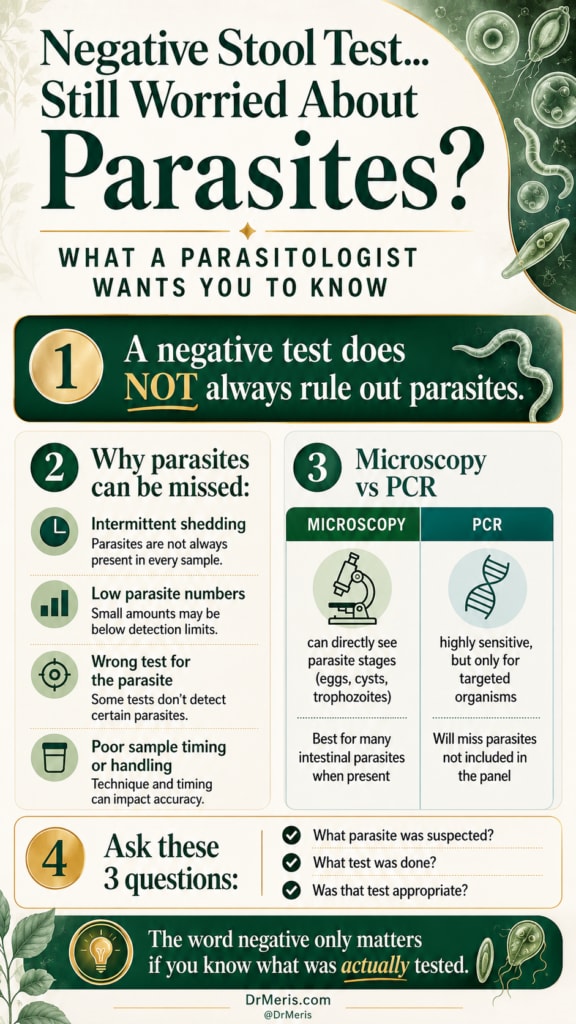
Can you have parasites with a negative stool test? Yes, in some cases you can. A negative result does not always exclude an intestinal parasitic infection because detection depends on the parasite, the number of organisms present, the timing and quality of the sample, and the laboratory method used.
I am a parasitologist, and part of my research involves intestinal parasites, microscopy, and molecular methods such as PCR. One thing I often notice is that stool testing is discussed online as if there were one universal “parasite test.” There isn’t.
Some parasites are shed irregularly. Some require special stains or concentration techniques. Others are better detected using antigen tests or molecular methods. A routine stool examination may therefore be useful for one infection but less suitable for another.
This also works in the opposite direction: symptoms such as bloating, abdominal discomfort, diarrhea, or constipation do not automatically mean that parasites are present.
For related digestive-health guides, you may also enjoy Natural Remedies for Constipation and Do Probiotics Really Work?.
The most useful question after a negative stool test is not simply “Do I still have parasites?” It is: What parasite was being considered, and was the right test used to look for it?
Quick Answer
A stool test can occasionally be negative even when a person is infected with an intestinal parasite.
Possible reasons include:
- The parasite was not being shed in that particular stool sample.
- Only a small number of parasites were present.
- The test used was not designed to detect that species.
- Special staining or concentration methods were needed.
- The sample was poorly collected, stored, or preserved.
- Microscopy did not detect a low-level infection.
- A PCR panel did not include the parasite involved.
For traditional ova and parasite examination, the U.S. Centers for Disease Control and Prevention (CDC) recommends examining three or more stool samples collected on separate days when this type of testing is indicated.1
A negative result does not have exactly the same meaning for every parasite. Parasite biology, shedding patterns, specimen quality, and the laboratory method all influence detection.
Bottom line: A negative stool test can be reassuring, but its meaning depends on what was tested and how.
Why Can a Stool Test Miss Intestinal Parasites?
One important reason is intermittent shedding.
Many intestinal parasites release eggs, cysts, oocysts, or larvae into the stool, but the number present is not necessarily the same every day.
This means that one stool specimen may contain detectable parasite stages while another sample from the same infected person may not.
A 2024 study published in PLoS Neglected Tropical Diseases examined this problem using Giardia infection as a model. The researchers showed that intermittent shedding, combined with imperfect microscopy sensitivity, can influence whether infection is detected in an individual stool sample.2
Laboratory diagnosis therefore depends on two things:
- The parasite, or enough of its diagnostic material, must be present in the specimen examined.
- The test must be able to detect it.
If either condition is not met, the result can be negative.
This does not mean that stool testing is unreliable. It means that results have to be interpreted with an understanding of the parasite and the method used.
Bottom line: Parasite detection is partly a sampling problem, and one specimen may not always contain enough diagnostic material to detect an infection.
Is One Stool Sample Enough?
Sometimes it is. Sometimes it is not.
For conventional ova and parasite examination, commonly called an O&P test, examining more than one specimen can improve detection.
The CDC recommends examining three or more stool specimens collected on separate days when O&P testing is appropriate.1
Research has also shown why repeated sampling can matter. In a study by Hiatt and colleagues, examining additional specimens increased detection of pathogenic intestinal protozoa compared with relying on a single specimen.3
However, this does not mean that every person needs three samples for every type of parasite test.
Modern antigen assays and molecular tests can have different sensitivities and different sampling requirements.
The appropriate strategy also depends on which parasite is suspected.
Testing for Giardia, for example, is not necessarily approached in exactly the same way as testing for Strongyloides, Cyclospora, or other intestinal parasites.
Bottom line: The more useful question is: Which organism are we trying to detect, and what test is most appropriate for it?
What Does an Ova and Parasite Stool Examination Look For?
An ova and parasite examination usually involves looking for recognizable parasite stages in stool.
Depending on the organism, these can include:
- Eggs
- Cysts
- Trophozoites
- Larvae
- Oocysts
The sample may be examined directly or processed using concentration techniques before microscopy.
Special stains may also be needed for certain organisms.
This is one reason parasitology microscopy requires experience. Parasites are identified partly through their morphology: their shape, size, internal structures, and other microscopic characteristics.
Some organisms are also difficult to distinguish from closely related species based on morphology alone.
For example, certain Entamoeba species can be morphologically similar, making antigen or molecular testing useful when species-level identification is important.
The CDC’s DPDx diagnostic resources include microscopy, concentration methods, staining, antigen detection, and molecular diagnosis because each method has a different role.4
No single laboratory method is ideal for every intestinal parasite. Microscopy, antigen detection, staining methods, and PCR can each answer different diagnostic questions.
Bottom line: O&P examination is useful, but its performance depends on the organism, specimen quality, and laboratory method.
How Reliable Is Parasite Microscopy?
Microscopy remains an important tool in parasitology, but its sensitivity is not perfect.
Detection depends on several factors, including:
- Parasite burden
- Whether the organism is being shed at the time of sampling
- How much specimen is examined
- The concentration method used
- Staining quality
- Preservation
- The experience of the examiner
The 2024 Giardia study mentioned earlier is particularly useful because it showed that diagnostic sensitivity can vary with both biological shedding patterns and microscopy performance.2
Recognizing parasite stages under the microscope is a technical skill. Training and experience matter, especially when parasite numbers are low or morphology is difficult to interpret.
Bottom line: Microscopy remains valuable, but low parasite burden and difficult morphology can reduce detection.
Can PCR Detect Parasites That Microscopy Misses?
Yes, in some cases.
PCR, or polymerase chain reaction, detects specific genetic material from the parasite.
Instead of relying on visual identification of an egg, cyst, trophozoite, or larva, PCR searches for selected DNA sequences.
This can be especially useful when:
- Parasite numbers are low.
- Species are difficult to distinguish morphologically.
- Mixed infections are suspected.
- Precise species identification is needed.
Several studies comparing molecular methods with conventional microscopy have found that PCR can detect additional infections for some intestinal parasites.56
However, PCR also has limitations.
A PCR assay is designed around specific targets.
If a parasite is not included in the test panel, the assay will not detect it simply because PCR is a sensitive technology.
Myth: A negative parasite PCR means that every possible parasite has been excluded.
Fact: PCR generally detects only the organisms that the assay was designed to target.
Bottom line: PCR can be highly sensitive for targeted parasites, but “molecular” does not mean “detects everything.”
PCR vs Microscopy for Intestinal Parasites
Both methods can be useful, but they answer somewhat different questions.
| Feature | Microscopy | PCR |
|---|---|---|
| What it detects | Eggs, cysts, larvae, trophozoites, oocysts, or other parasite structures | Parasite DNA |
| Morphological expertise required | Yes | Not for visual identification |
| Can reveal unexpected parasites | Potentially | Usually limited to organisms included in the assay |
| Low parasite burden | Detection can be difficult | Often more sensitive for targeted organisms |
| Species differentiation | May be difficult for similar organisms | Often very useful |
| Cost | Usually lower | Often higher |
| Major limitation | Depends on parasite burden, preparation, and examiner expertise | Limited to the molecular targets included |
A broad microscopic examination may reveal parasites that would not be detected by a targeted PCR panel if those organisms were not included among the assay’s targets.
At the same time, PCR can provide highly sensitive and specific detection for selected parasites and may detect infections missed by conventional microscopy.
Microscopy and PCR can be complementary rather than interchangeable. Which method is more useful depends on the parasite and the diagnostic question.
Bottom line: The best test is the one that fits the organism being investigated.
Can a Parasite Be Missed Because the Laboratory Did Not Test for It?
Yes.
This is one of the most important things to understand about parasite testing.
A person might say:
“My parasite test was negative.”
But that could mean several different things.
They may have had:
- Routine O&P microscopy
- A Giardia antigen test
- A Cryptosporidium antigen test
- A multiplex gastrointestinal PCR panel
- An acid-fast stain
- Another targeted investigation
These tests are not equivalent.
A good example is Cyclospora cayetanensis.
The CDC specifically notes that testing for Cyclospora may need to be requested and that not all gastrointestinal PCR panels include it.7
Patients may also shed relatively few oocysts, so more than one stool specimen may sometimes be needed.
A test cannot detect a parasite that it was not designed to look for.
Bottom line: “Negative” only tells you about the organisms that the test was capable of detecting.
Can Giardia Be Missed on a Stool Test?
Yes.
Giardia duodenalis is a good example of why sampling matters.
People infected with Giardia do not necessarily shed the same number of cysts in every stool specimen.
As a result, one sample may be positive while another may be negative.
The CDC recommends collecting three stool samples over several days when testing for giardiasis.8
Giardia testing methods can include
- Microscopy
- Direct fluorescent antibody testing
- Antigen detection
- Molecular assays
Intermittent shedding is one reason a single negative stool specimen does not always exclude Giardia.
Bottom line: If giardiasis is genuinely suspected, both the diagnostic method and the sampling strategy matter.
What About Cryptosporidium?
Cryptosporidium may also require specific diagnostic methods.
Options can include:
- Microscopy with appropriate staining
- Direct fluorescent antibody testing
- Antigen detection
- Molecular testing
The CDC notes that stool antigen tests are available for organisms including Cryptosporidium, Giardia duodenalis, and Entamoeba histolytica.9
The diagnostic method needs to match the organism being investigated. One routine stool test is not equally sensitive for every parasite.
Bottom line: Different parasites may require different laboratory methods.
What About Strongyloides?
Strongyloides stercoralis is another important example.
Routine stool examination has limited sensitivity for Strongyloides, particularly in uncomplicated infections where the number of larvae passed in stool may be low.
Serial stool examinations and specialized methods such as Baermann concentration or agar plate culture can improve detection.
Serological testing may also be useful in some clinical situations.
This matters because Strongyloides has an unusual autoinfective life cycle and can persist for many years. Infection can become much more serious in people who later become immunosuppressed.
If Strongyloides is specifically suspected, one routine negative stool examination may not be sufficient to exclude infection.
Bottom line: Strongyloides is a good example of why a negative result must be interpreted according to the parasite being investigated.
Can Poor Sample Collection Affect Parasite Testing?
Yes.
Collection, storage, and preservation can influence what the laboratory is able to detect.
Depending on the test, the laboratory may provide containers containing specific preservatives.
Some fresh specimens need to reach the laboratory quickly, while preserved specimens can be handled differently.
The CDC notes that specimen preservation is important when immediate examination is not possible and provides specific collection guidance for parasitological testing.10
For molecular tests, proper specimen handling is also important because the quality of nucleic acid can affect analysis.
Follow the collection and preservation instructions provided by the laboratory. Different tests may require different handling conditions.
Bottom line: Even a good diagnostic test depends on receiving an appropriate specimen.
Does a Negative Blood Test Rule Out Intestinal Parasites?
No.
There is no single blood test that screens for every human parasite.
Blood testing can be useful for certain infections, but its value depends on the organism.
Some parasitic infections may be investigated using:
- Serology
- Antigen detection
- Blood-film microscopy
- Molecular tests
- Routine laboratory markers
Many intestinal infections, however, are diagnosed primarily through stool-based testing.
Myth: Normal routine blood results mean that intestinal parasites have been ruled out.
Fact: There is no single routine blood test that excludes every intestinal parasite.
Bottom line: A normal routine blood test cannot be used as proof that someone is free of all intestinal parasites.
Does a Normal Eosinophil Count Rule Out Parasites?
No.
Eosinophilia can occur with some parasitic infections, particularly helminths that invade or migrate through tissues.
But many intestinal parasitic infections do not necessarily cause eosinophilia.
Protozoal infections such as Giardia, for example, are not typically diagnosed by looking for an elevated eosinophil count.
So normal eosinophils do not exclude every parasitic infection.
At the same time, an elevated eosinophil count does not automatically mean that someone has parasites either. Allergic diseases, medications, inflammatory disorders, and other conditions can also increase eosinophils.
Eosinophils are one clinical clue among many. They are not a universal screening test for intestinal parasites.
Bottom line: Normal eosinophils do not prove that parasites are absent, and elevated eosinophils do not prove that parasites are present.
Do Bloating and Constipation Mean You Have Parasites?
No.
Bloating, constipation, gas, abdominal pain, nausea, and changes in bowel habits are all nonspecific symptoms.
They can have many possible causes, including:
- Dietary changes
- Low fibre intake
- A sudden increase in fibre
- Inadequate fluid intake
- Functional constipation
- Irritable bowel syndrome
- Food intolerance
- Medication
- Altered gut motility
- Infection
- Other gastrointestinal conditions
Digestive symptoms alone cannot diagnose a parasitic infection. Their causes overlap too much for symptoms to identify the organism reliably.
If constipation is your main concern, you can also read my DrMeris guide on Natural Remedies for Constipation, where I compare commonly recommended options according to the strength of the scientific evidence.
For a broader look at the gut microbiome and digestive symptoms, see Do Probiotics Really Work? The Complete Evidence-Based Guide.
Bottom line: Symptoms can suggest that something needs investigation, but they cannot diagnose a parasite by themselves.
Can You Diagnose Worms by Looking at Your Stool?
Not reliably.
People sometimes notice something unusual in stool and assume it is a worm.
Occasionally it may be.
But mucus, plant fibres, undigested food, and other material can also look surprisingly similar to parasites.
In laboratory parasitology, identification is based on specific morphological features rather than simply on whether something looks long, pale, or worm-like.
Parasite identification depends on specific morphological features and appropriate laboratory examination. Naked-eye appearance is often not enough.
Bottom line: Professional laboratory examination is more reliable than self-diagnosis based on appearance alone.
What About Parasite Cleanses?
I would be cautious with them.
Different parasites have very different biology.
A protozoan such as Giardia is very different from a tapeworm, hookworm, Strongyloides, or Cryptosporidium.
It therefore makes little scientific sense to assume that one general “parasite cleanse” can reliably treat all intestinal parasites.
When a parasitic infection is diagnosed, treatment is usually selected according to the organism involved.
Myth: One general cleanse can remove any hidden intestinal parasite.
Fact: Different parasites require different diagnostic and treatment approaches.
Using herbal or commercial cleanses without a diagnosis can also delay investigation of the actual cause of persistent symptoms.
If testing is negative but there is still a genuine clinical reason to suspect infection, it is usually more useful to ask:
Which parasite is suspected, and was the correct test used?
Bottom line: Appropriate diagnosis is more reliable than starting a nonspecific parasite cleanse.
When Should a Negative Stool Test Be Investigated Further?
A negative result often does mean that infection is less likely.
Further investigation may be considered when there is still a meaningful reason to suspect parasitic infection.
Examples include
- Persistent unexplained gastrointestinal symptoms
- Relevant travel or residence history
- Consumption of potentially contaminated food or water
- Exposure to freshwater in endemic areas
- Immune suppression
- Unexplained laboratory abnormalities
- A known outbreak
- Household or occupational exposure
- Symptoms strongly suggestive of a particular infection
The next step is not always another identical stool test.
Sometimes the more appropriate approach is a different laboratory method altogether.
Repeat testing should be based on the suspected parasite, the method already used, and the clinical context—not repeated automatically.
Bottom line: The next test should answer a specific diagnostic question.
My View as a Parasitologist
One reason I wanted to write this article is that parasite diagnosis has become very oversimplified online.
I work with intestinal parasites using methods that include microscopy and molecular approaches such as PCR, and laboratory parasitology is more nuanced than:
positive = parasite
and
negative = definitely no parasite.
A good parasitological investigation considers the biology of the organism.
Where does the parasite live?
Which life stage is present in humans?
Which stage is released in stool?
Is shedding continuous or intermittent?
Which specimen should be collected?
Can the organism be identified reliably by microscopy?
Would antigen testing or PCR provide more useful information?
All of these questions affect how we interpret a test result.
At the same time, it is equally important not to assume that every unexplained digestive symptom is caused by a hidden parasite.
Most gastrointestinal symptoms have many possible explanations.
Good diagnosis means avoiding both extremes: a single negative test does not automatically exclude every parasitic infection, but unexplained digestive symptoms should not automatically be blamed on parasites either.
Summary: Parasite Testing at a Glance
| Question | What to know |
|---|---|
| Can one stool test miss parasites? | Yes. Intermittent shedding and low parasite burden can reduce detection. |
| Are three samples always needed? | No. Multiple specimens are recommended for conventional O&P testing, but other tests may have different requirements. |
| Is PCR always better? | No. PCR can be very sensitive for targeted organisms but only detects organisms included in the assay. |
| Does microscopy still matter? | Yes. It directly visualizes parasite stages and may reveal organisms not included in targeted molecular panels. |
| Can Giardia be missed? | Yes. Intermittent shedding can affect detection. |
| Do normal eosinophils exclude parasites? | No. Not all parasitic infections cause eosinophilia. |
| Does bloating mean parasites? | No. Bloating is nonspecific and has many possible causes. |
| Should you use a parasite cleanse? | There is no universal evidence-based cleanse for all intestinal parasites. |
Related Articles
Key Takeaways
- A negative stool test does not always exclude every intestinal parasite.
- Parasites may be shed intermittently or in low numbers.
- Different parasites require different diagnostic approaches.
- Multiple specimens can improve detection with conventional O&P examination.
- PCR can be highly sensitive but generally detects only organisms included in the assay.
- Microscopy and PCR can complement each other.
- Giardia, Cyclospora, Cryptosporidium, and Strongyloides show why test selection matters.
- Normal eosinophils do not rule out every parasitic infection.
- Bloating or constipation alone does not mean you have parasites.
- Appropriate diagnosis is more reliable than nonspecific parasite cleanses.
The Bottom Line
Yes, it is possible to have parasites with a negative stool test, but the significance of a negative result depends on the parasite and the test used.
A single stool sample can sometimes miss infection because parasite shedding may be intermittent or parasite numbers may be low.
For conventional ova and parasite examination, the CDC recommends examining three or more stool specimens collected on separate days when this type of testing is indicated.1
PCR can provide highly sensitive and specific detection for many targeted organisms and can sometimes identify infections missed by conventional microscopy. However, PCR panels are limited to the parasites they are designed to detect.
- Which parasite was suspected?
- Which test was performed?
- Was that test appropriate for that parasite?
Those questions tell us much more than the word negative alone.
Frequently Asked Questions
Can one negative stool test rule out parasites?
Not always. Some parasites are shed intermittently or in low numbers, so a single specimen may occasionally miss infection. The meaning of a negative result depends on the organism and the test used.
How many stool samples are needed to check for parasites?
For conventional ova and parasite examination, the CDC recommends three or more stool specimens collected on separate days when this type of testing is indicated. Other tests may have different requirements.
Is PCR better than microscopy for parasites?
PCR can be more sensitive for some targeted parasites and is useful for precise species identification. Microscopy remains valuable because it can directly visualize parasite stages and may reveal organisms not included in a targeted PCR panel. The methods are often complementary.
Can Giardia be missed in one stool sample?
Yes. Giardia shedding can vary from one specimen to another. The CDC recommends collecting three stool specimens over several days when testing for giardiasis.
Can a parasite PCR test be negative even if you have a parasite?
Yes. No test has perfect sensitivity, and PCR panels usually test only for selected organisms.
Does a normal blood test mean I do not have parasites?
No. There is no single routine blood test that excludes every parasitic infection.
Does a normal eosinophil count rule out parasites?
No. Some helminth infections are associated with eosinophilia, particularly when tissue migration occurs, while many intestinal protozoal infections may not increase eosinophils.
Does bloating mean I should get tested for parasites?
Not necessarily. Bloating is very common and has many possible causes. Parasite testing is more useful when symptoms are combined with relevant exposure, travel, epidemiological, or clinical factors.
Should I take a parasite cleanse after a negative test?
There is no evidence-based universal cleanse that treats all intestinal parasites. If infection is still suspected, identifying the likely organism and choosing the appropriate diagnostic method is more reliable than self-treatment with a nonspecific cleanse.
References
Click to view references
- Centers for Disease Control and Prevention (CDC). Diagnosis of Parasitic Diseases. Updated April 9, 2024. CDC source
- Ferreira-Sá LCE, Machado ER, Gurgel-Gonçalves R, Abad-Franch F. Disentangling the effects of intermittent faecal shedding and imperfect test sensitivity on the microscopy-based detection of gut parasites in stool samples. PLoS Neglected Tropical Diseases. 2024;18:e0012719. doi:10.1371/journal.pntd.0012719
- Hiatt RA, Markell EK, Ng E. How many stool examinations are necessary to detect pathogenic intestinal protozoa? American Journal of Tropical Medicine and Hygiene. 1995;53(1):36–39. PubMed
- Centers for Disease Control and Prevention (CDC), DPDx. Stool Specimens: Diagnostic Procedures. CDC DPDx
- Autier B, et al. Selecting a multiplex PCR panel for accurate molecular diagnosis of intestinal protists: a comparative study of Allplex®, G-DiaParaTrio and RIDA®GENE assays and microscopic examination. Parasite. 2022;29. Full text
- Llewellyn S, et al. Application of a multiplex quantitative PCR to assess prevalence and intensity of intestinal parasite infections in a controlled clinical trial. PLoS Neglected Tropical Diseases. 2016;10(1):e0004380. doi:10.1371/journal.pntd.0004380
- Centers for Disease Control and Prevention (CDC). Clinical Overview of Cyclosporiasis. CDC source
- Centers for Disease Control and Prevention (CDC). Clinical Testing and Diagnosis for Giardia Infection. Updated February 8, 2024. CDC source
- Centers for Disease Control and Prevention (CDC), DPDx. Stool Specimens: Detection of Parasite Antigens. CDC DPDx
- Centers for Disease Control and Prevention (CDC), DPDx. Stool Specimens: Specimen Collection. CDC DPDx
This article is for educational purposes only and is not intended to diagnose or treat any medical condition. If you have persistent symptoms or concerns about parasitic infection, speak with a qualified healthcare professional.
Sign Up for Our Email List
Get our latest articles, healthy recipes, tips, and exclusive deals delivered straight to your inbox with our newsletter.
We won't send you spam. Unsubscribe at any time.