 Meriem Taleb, PhD
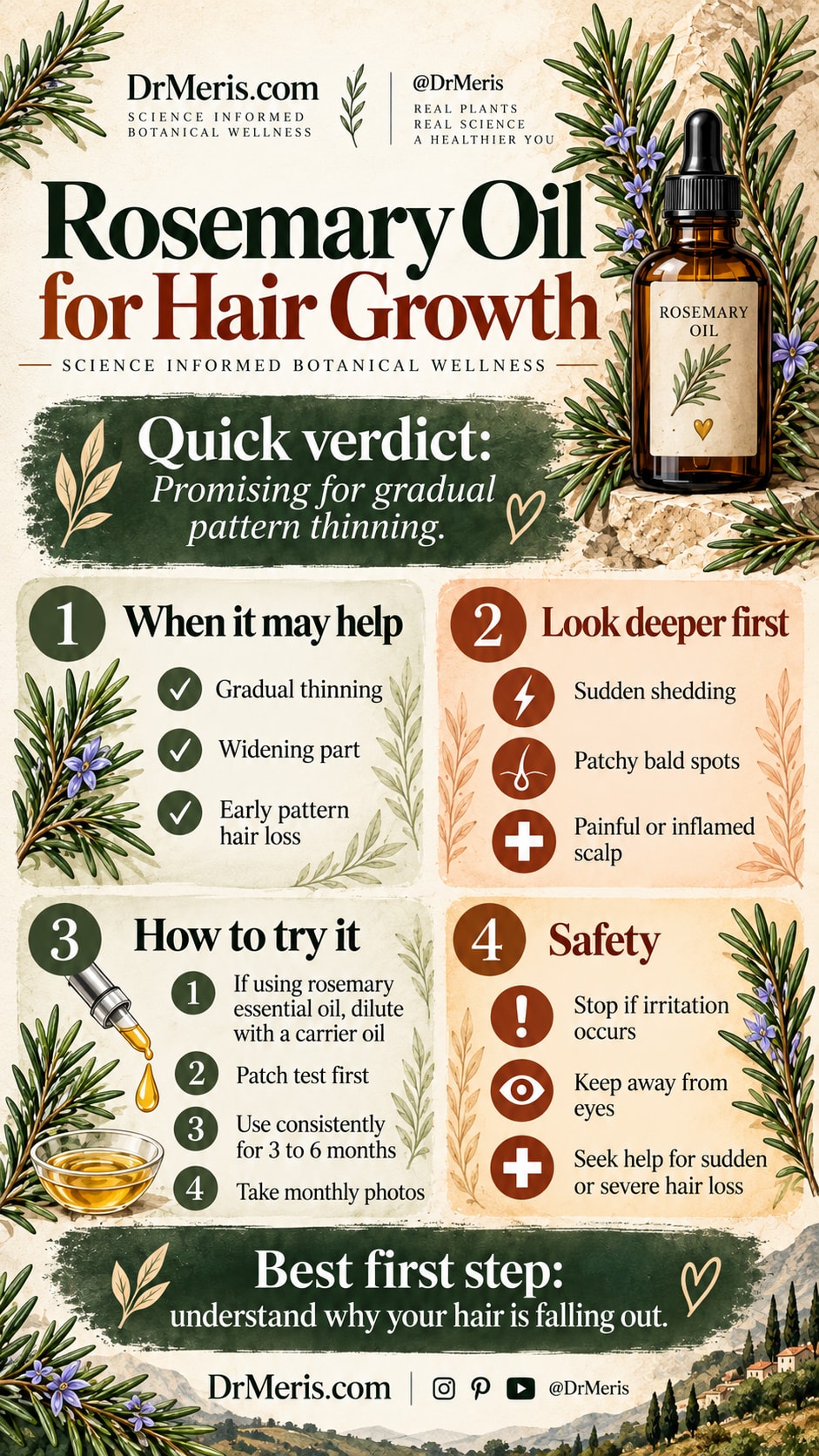
Can rosemary oil for hair growth really help? The answer is encouraging: a human clinical trial found increased hair counts after six months of using a rosemary oil lotion in men with pattern hair loss. Rosemary is a promising botanical option, particularly when hair becomes gradually thinner over time. But whether it is right for you depends on something more important than any trend: why your hair is falling out in the first place.1
I have a soft spot for medicinal plants, especially when an everyday herb turns out to have a story worth investigating. Rosemary is one of those plants. If you are noticing more hair in your brush or a widening part, you probably want to know whether it could help you, not whether natural treatments win some imaginary competition with conventional ones. That is the question I want to explore.
We will look at what different patterns of hair loss can mean, what studies have found about rosemary oil, and how to give it a sensible try if it seems suitable for you.
For more on the science behind botanical ingredients, you may enjoy my DrMeris articles on Spanish Lavender and Natural Vitamin C Masks.
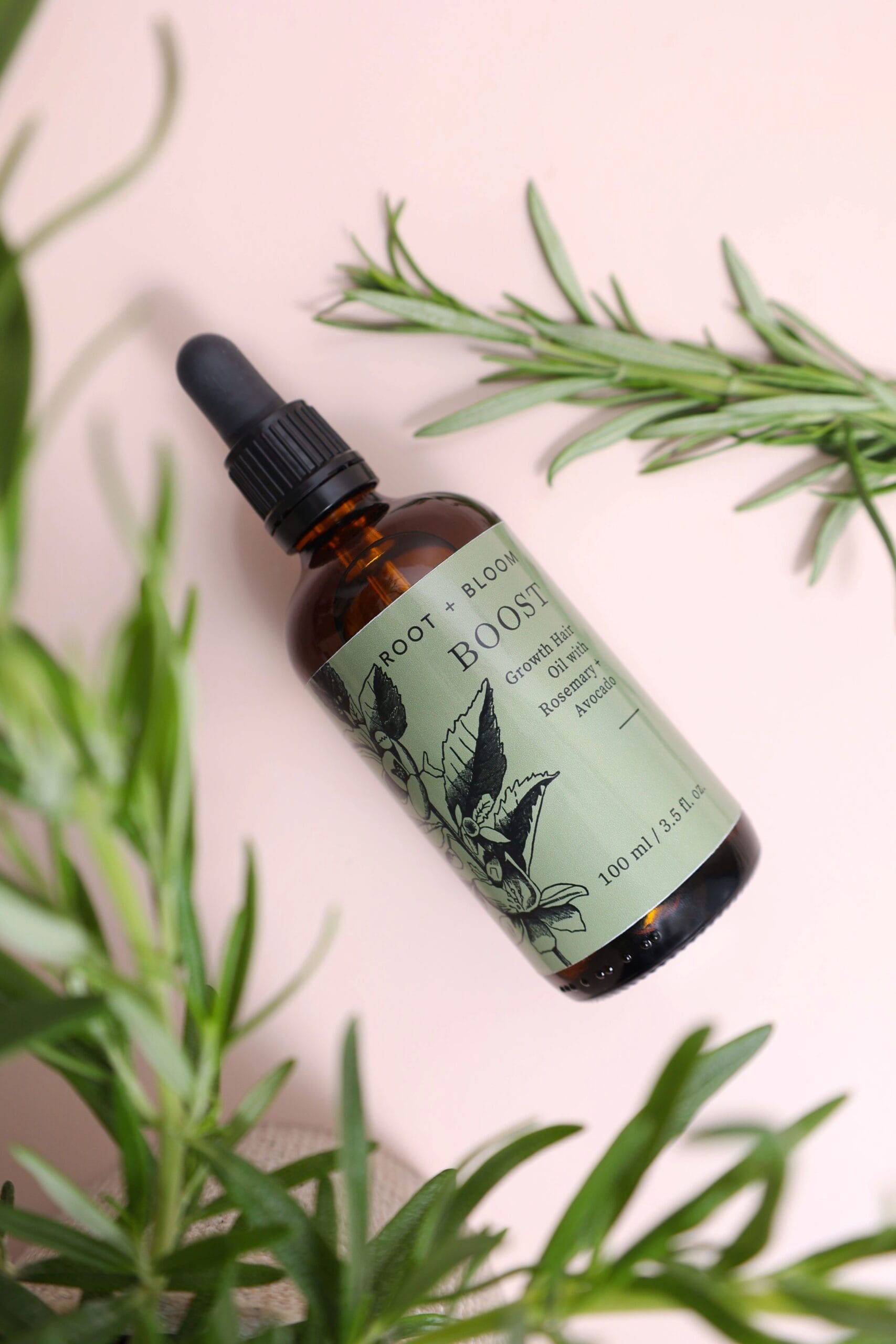
The interesting part is that rosemary has shown a positive result in a human study. That makes it worth discussing. The key is working out whether your particular kind of hair loss resembles the one studied.
Quick Answer: Is Rosemary Oil Worth Exploring?
Yes, particularly if you have gradual pattern hair thinning and prefer a botanical scalp care option. In a randomized six month trial, participants using a rosemary oil lotion experienced increased hair counts. Participants using 2% minoxidil also improved; the study did not find a significant difference between the groups.1
I find that result encouraging. I would just keep in mind that the researchers used a particular lotion in people with pattern hair loss. A bottle of essential oil or homemade rosemary water is not necessarily the same thing.
For gradual pattern thinning, rosemary looks promising. We still need larger studies to understand which preparations work best and who benefits most.
Why Does Hair Fall Out in the First Place?
Hair naturally cycles through growth, transition, rest, and shedding. It is normal to lose some hairs every day. What deserves attention is a noticeable change in density, repeated excessive shedding, a widening part, or distinct bare patches.
Common reasons include inherited sensitivity of hair follicles to androgens (pattern hair loss), physical or emotional stress, childbirth, fever or illness, rapid weight loss, low iron or inadequate nutrition, thyroid disorders, certain medications, tight hairstyles, inflammatory scalp conditions, and autoimmune disease.2
It is also possible to have more than one cause. For example, someone with slowly thinning hair may suddenly shed more after an illness. Thinking about when the changes began can provide useful clues.
Start with three simple questions. Has your hair been gradually getting finer? Did the shedding begin suddenly? Or have you noticed one or more distinct bare patches? Your answers can help you decide what to investigate next.
Which Types of Hair Loss Might Respond to Rosemary Oil?
The table below is a practical starting point, not a diagnosis.
| What you notice | Possible explanation | Where rosemary oil fits |
|---|---|---|
| Gradual thinning at the crown, temples, or widening part | Androgenetic alopecia (pattern hair loss) | Most promising use. The main rosemary clinical trial examined this condition. |
| Sudden diffuse shedding a few months after illness, childbirth, major stress, or weight loss | Telogen effluvium | Addressing the trigger is most important; rosemary has not been established as a treatment for this type. |
| Round, smooth bald patches | Alopecia areata | An older trial studied a combination of essential oils, including rosemary, but cannot isolate rosemary’s effect. |
| Hair breaks easily, especially after heat, bleaching, or tight hairstyles | Hair-shaft damage or traction | Reducing damage and tension matters more than promoting follicle growth. |
| Hair loss with burning, pain, redness, scaling, or shiny scar-like areas | Inflammatory or scarring alopecia | Seek dermatologic assessment promptly; delaying appropriate care risks permanent loss. |
For alopecia areata, the immune system attacks follicles; in many cases follicles remain capable of regrowth. This differs considerably from inherited pattern thinning.3
If thinning has developed slowly over many months or years, rosemary oil may be a reasonable option to discuss or explore. If shedding begins suddenly or occurs in patches, prioritize finding the cause before choosing a botanical treatment.
What Do Scientific Studies Say About Rosemary Oil for Hair Growth?
The 2015 clinical study: encouraging results
Panahi and colleagues randomly assigned 100 men with androgenetic alopecia to a rosemary oil lotion or 2% minoxidil for six months. Hair counts did not improve significantly at three months, but both groups showed statistically significant increases by six months. There was no statistically significant between-group difference in hair counts. Scalp itching was reported more often in the minoxidil group.1
I find this trial worth highlighting because it moved beyond laboratory speculation to a measured human outcome. A 2025 review of nonprescription products also describes the formulation and the hair count findings.4
It is also useful to understand the boundaries: the study compared two active preparations rather than including a carrier oil only control. “No significant difference” is not the same thing as proving the two treatments equivalent. These are reasons to study rosemary more, not reasons to dismiss the positive result.
The aromatherapy study: a different kind of hair loss
A 1998 randomized study reported improvement in alopecia areata with a mixture of thyme, rosemary, lavender, and cedarwood essential oils in carrier oils. This supports further interest in botanical scalp formulations, but the study cannot show how much rosemary contributed individually.5
The encouraging finding is increased hair counts with a specific rosemary formulation over six months. The unanswered questions concern optimal formulation, consistency of response, long term use, and effectiveness in other forms of hair loss.
How Could Rosemary Oil Support Hair Growth?
Rosemary (Salvia rosmarinus, formerly Rosmarinus officinalis) produces aromatic compounds such as 1,8-cineole, camphor, and α-pinene. Its composition can vary with the plant material and preparation.6
Researchers have discussed several biologically plausible pathways: effects on local microcirculation, antioxidant activity, and modulation of inflammatory processes. These mechanisms are interesting because follicles are living mini-organs influenced by their surrounding tissue.
However, laboratory or mechanistic findings cannot establish that a product will regrow human hair. Claims about precisely blocking DHT in the scalp are also stronger than the current human evidence allows.
Rosemary contains many compounds, and their proportions vary between preparations. That is fascinating from a botanical perspective, but it also means that a tested lotion and a homemade infusion are not interchangeable.
How to Explore Rosemary Oil for Hair Growth: A Practical Routine
If your thinning is gradual and you have no concerning scalp symptoms, consider the following approach:
- Choose the product carefully. Look for a reputable, clearly labeled topical scalp product. A professionally formulated rosemary preparation is easier to use consistently than a homemade mixture of unknown concentration.
- Protect your skin. Do not apply concentrated undiluted essential oil directly to the scalp. Follow product instructions. If you use a diluted preparation, seek reliable professional guidance on concentration and compatibility.
- Try a small area first. Watch for itching, redness, burning, or a rash. Stop if irritation develops; allergy can still occur after a previously uneventful test.
- Be consistent rather than aggressive. The main trial followed participants for six months. Applying more oil than recommended is not known to produce better outcomes.
- Track changes reasonably. Photograph your scalp every four weeks in the same light, parting, and position. Compare overall density rather than counting loose hairs daily.
- Review your progress. If thinning worsens, or no useful improvement occurs, discuss other explanations and treatment choices with a clinician.
Do not swallow rosemary essential oil, use it on broken skin, or put it near the eyes. Consult an appropriate professional before use during pregnancy or breastfeeding, for children, or if you have an active scalp condition.
A gentle, realistic routine is more useful than a “miracle growth challenge.” Choose a preparation you tolerate, use it as directed, and give your hair cycle time to show a meaningful trend.
What Else Should You Explore if You Are Losing Hair?
I would never approach hair health as a question of which oil to buy alone. Follicles depend on adequate energy, protein, micronutrients, and a healthy scalp environment.
- Consider nutrition. Very restrictive diets, rapid weight loss, inadequate protein, and some nutrient deficiencies may contribute to shedding. Supplement only for a demonstrated or clinically suspected need; more of a vitamin is not always better.
- Look at recent changes. Illness, fever, childbirth, surgery, and major stress can precede temporary shedding by weeks or months.
- Notice scalp symptoms. Persistent itching, scaling, inflammation, or pain suggests a problem that deserves specific attention.
- Reduce mechanical damage. Tight hairstyles, repeated heat, harsh processing, and traction can worsen visible thinning or breakage.
- Seek targeted testing when appropriate. Depending on symptoms and history, a clinician may consider iron status, thyroid function, or other investigations rather than automatically ordering a long supplement panel.
For broader ideas on eating well, read my DrMeris article on science-backed nutrition habits. Improving overall nutritional adequacy is valuable even when it is not itself a specific hair-regrowth treatment.
The American Academy of Dermatology notes that some shedding resolves after its trigger passes, and not all hair loss requires the same treatment.2
When Might You See Results?
Hair changes slowly. In the six month rosemary oil trial, an increase in hair counts was observed at six months, not at three months.1
This gives readers a reasonable perspective, not a guaranteed deadline. If you explore rosemary, you might reassess photographs and scalp comfort monthly and review the overall picture after several months. Some people may notice little or no improvement. If an underlying trigger is responsible for shedding, improvement may come mainly from resolving that trigger rather than from any topical product.
A successful outcome might be gradual improvement in hair density or reduced progression of visible thinning, not necessarily dramatic regrowth.
Rosemary Oil and Other Approaches: What Fits Which Situation?
| Approach | Potential role | What to consider |
|---|---|---|
| Rosemary oil lotion | Promising botanical option for pattern thinning | One positive small human trial; formulation and results may vary. |
| Topical minoxidil | Established option for appropriate pattern hair loss | More extensive clinical evidence; ongoing use and potential irritation. |
| Dietary improvements | Important when intake is inadequate or a deficiency contributes | Not a universal regrowth treatment; investigate the cause. |
| Gentle hair care / reduced traction | Useful for breakage or tension-related hair loss | Cannot directly treat all follicle disorders. |
| Diagnosis-directed care | Essential for autoimmune, inflammatory, hormonal, or scarring causes | The correct approach depends on the identified condition. |
I think the best choice is the one that fits your hair loss, your preferences, and what you feel comfortable using consistently. Sometimes that might include a botanical scalp product. Sometimes it means looking for an underlying health problem first.
My View: Let Botanical Remedies Earn Their Place
I love that an herb familiar from gardens and kitchens can also become the subject of a clinical trial. That is one of the reasons I enjoy writing about natural health. Traditional use can give us ideas, and careful research helps us see which ones hold up.
Rosemary oil deserves more research. The positive clinical findings justify curiosity, and for people with gradual pattern thinning, a carefully chosen botanical scalp product may be a reasonable avenue to explore.
Before choosing an oil, take a good look at what your hair is doing. Gradual thinning, shedding after illness, and sudden bald patches are different situations. The most useful next step will depend on which one you are experiencing.
Rosemary oil is a promising natural option for some people with pattern hair thinning. Explore it thoughtfully: understand the cause, choose a suitable formulation, protect your scalp, follow changes over time, and use other approaches when the diagnosis calls for them.
Key Takeaways
- Rosemary oil showed a positive hair count result in a six month human trial involving men with pattern hair loss.
- Gradual pattern thinning is the hair loss type with the most directly relevant rosemary evidence.
- Sudden shedding, round bald patches, and inflamed or scarred scalp areas need a different approach.
- Quality, concentration, and product formulation matter; a DIY water infusion is not the same as a studied lotion.
- A practical plan also considers nutrition, scalp health, recent illnesses, stressors, and hair-care habits.
- Use a gentle, consistent routine and evaluate changes realistically rather than expecting overnight results.
Frequently Asked Questions
Does rosemary oil for hair growth actually work?
A randomized six month clinical trial found improved hair counts in men with androgenetic alopecia who used a rosemary oil lotion. The findings are encouraging, though more research is needed to learn how consistently different formulations work.
What type of hair loss is rosemary oil best for?
Gradual inherited pattern thinning is the condition most directly studied. There is much less evidence that rosemary alone helps other causes, such as sudden diffuse shedding or autoimmune patchy loss.
Can rosemary oil help hair loss caused by stress?
Stress-related shedding often follows a trigger and may improve after the trigger resolves. Rosemary has not been established as a specific treatment for telogen effluvium; explore the cause and seek advice if shedding continues.
How long does rosemary oil take to work?
In the main trial, statistically significant hair count increases were detected at six months but not at three months. That is a study result, not a guaranteed timetable for every person or product.
Is rosemary water the same as rosemary oil?
No. An aqueous infusion and an essential-oil preparation differ chemically. Evidence for a tested rosemary oil lotion cannot automatically be transferred to homemade rosemary water.
Can rosemary oil be used with minoxidil?
There is little direct clinical research on the combination. If you use minoxidil or another leave-on scalp treatment, ask your clinician or pharmacist before adding rosemary, particularly if your scalp is sensitive.
When should I see a dermatologist for hair loss?
Seek assessment for sudden or patchy loss, scalp pain, redness, marked scaling, scarring changes, rapidly worsening thinning, or persistent unexplained shedding.
The Bottom Line
Rosemary oil for hair growth is a promising natural option, especially for gradual pattern thinning. The best first step is to understand why you are losing hair. A rosemary scalp preparation may have a place in a thoughtful routine, while other forms of shedding require attention to nutrition, triggers, hormones, inflammation, or other underlying causes.
Related Articles
- Spanish Lavender: Benefits, Uses, Growing Tips, and What Science Says
- Do Natural Vitamin C Masks Really Work?
- 5 Natural Skincare Recipes for a Healthier Glowing Complexion
References
Click to view references
- Panahi Y, Taghizadeh M, Tahmasbpour Marzony E, Sahebkar A. Rosemary oil vs minoxidil 2% for the treatment of androgenetic alopecia: a randomized comparative trial. SKINmed. 2015;13(1):15 to 21. PubMed
- American Academy of Dermatology Association. Hair loss: Diagnosis and treatment. Patient education. AAD source
- American Academy of Dermatology Association. Alopecia areata: Causes. Patient education. AAD source
- Gupta et al. Do Non-Prescription Products Help in Managing Androgenic Alopecia? Review article, available through PubMed Central. Full text
- Hay IC, Jamieson M, Ormerod AD. Randomized trial of aromatherapy: successful treatment for alopecia areata. Archives of Dermatology. 1998;134(11):1349 to 1352. DOI
- Aćimović M, Miljković A. Systematic Evaluation of Rosemary Essential Oil in Aromatherapy Practice: A Review. 2025. DOI
This article is educational and does not diagnose or treat hair loss. For persistent, sudden, patchy, inflammatory, or otherwise concerning symptoms, consult a qualified healthcare professional.
Sign Up for Our Email List
Get our latest articles, healthy recipes, tips, and exclusive deals delivered straight to your inbox with our newsletter.
We won't send you spam. Unsubscribe at any time.