 Meriem Taleb, PhD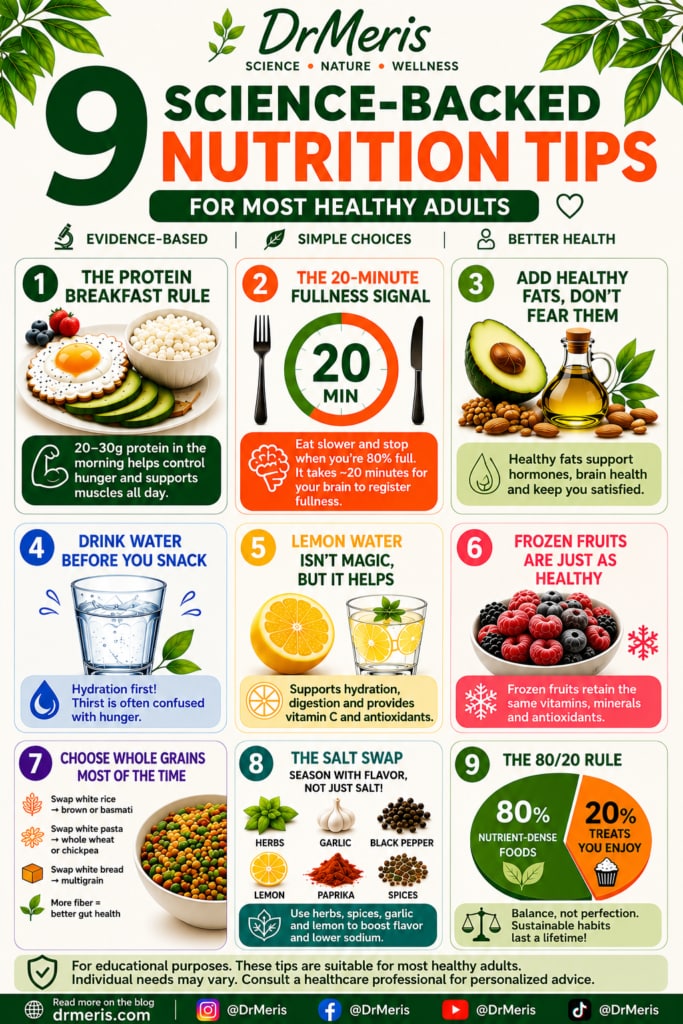
Science-backed nutrition tips should make healthy eating easier, not more confusing. Yet every week, social media introduces a new food rule, a miracle drink, or a diet trend that promises dramatic results. The habits that genuinely matter are usually much simpler: they are practical, repeatable, and realistic enough to maintain.
The strongest nutrition advice is not about eating perfectly. It is about improving your usual eating pattern with more protein when it helps fullness, more fiber-rich foods, more colorful plants, healthier fats, less excess salt, and enough water. Healthy dietary patterns are consistently linked with better cardiovascular and metabolic health and a lower risk of chronic disease.1
These habits may also support healthy weight management and make nutritious eating easier to sustain over time.2 In this guide, you will find nine practical, science-backed nutrition tips for most healthy adults, not detoxes, rigid rules, or unrealistic promises.
This article is for educational purposes and provides general nutrition guidance for healthy adults. Individual needs may differ, especially during pregnancy or for people with medical conditions, allergies, eating disorders, or prescribed therapeutic diets.
For related evidence-based guides, you may also enjoy Natural Remedies for Constipation, Do Probiotics Really Work?, and Lower Blood Pressure Naturally.
Healthy eating is not about perfection. It is about building habits you can maintain for years, not days.
Tip 1 — Start Your Day With Protein
One of the most useful science-backed nutrition tips is to include protein at breakfast. Breakfast is often the lowest-protein meal of the day, especially when it is based on sugary cereal, pastries, or refined bread.
Increasing protein intake at breakfast can improve satiety and may reduce hunger later in the day.3 Protein also stimulates hormones involved in fullness, including peptide YY and GLP-1, while reducing ghrelin, a hormone linked to hunger.4
Randomized trials suggest that higher-protein breakfasts may reduce evening snacking and improve appetite control compared with lower-protein breakfasts.5
Protein-rich breakfasts can help some people feel fuller for longer and may reduce later snacking.
Easy protein breakfast ideas
- Eggs with whole-grain toast
- Greek yogurt with berries
- Cottage cheese with fruit
- Oatmeal with milk, nuts, or seeds
- Smoothie with yogurt or milk
Bottom line: A protein-rich breakfast will not magically cause weight loss, but it can help improve fullness and make healthy eating easier.
Tip 2 — Wait 20 Minutes Before Taking Seconds
Your stomach fills quickly, but your brain needs time to register fullness. Satiety signals involve hormones such as GLP-1, peptide YY, and cholecystokinin, which increase after eating and help the brain recognize that you have had enough.6
Eating too quickly may reduce the time available for these fullness signals to develop before extra food is consumed.7 Observational studies have reported that faster eating is associated with higher body weight and greater risk of obesity.8
Myth: Fullness happens immediately when your stomach is full.
Fact: Satiety develops gradually through hormonal and neural signals after eating begins.
Try this simple habit
- Finish your plate slowly.
- Put your fork down.
- Drink water.
- Wait about 20 minutes before taking seconds.
Bottom line: Slowing down can help you recognize fullness before overeating.
Tip 3 — Do Not Fear Healthy Fats
For many years, people were told to avoid fat. Modern nutrition science shows that the type of fat matters more than simply avoiding all fat.9
Unsaturated fats found in olive oil, nuts, seeds, avocados, and fatty fish are associated with better cardiovascular health when they replace saturated or trans fats.10
The PREDIMED trial showed that a Mediterranean dietary pattern enriched with extra-virgin olive oil or mixed nuts reduced major cardiovascular events in people at high cardiovascular risk.11
★★★★★ Strong
Supported by large clinical trials and long-term nutrition research.
Healthy fat sources
- Olive oil
- Avocado
- Nuts
- Seeds
- Fatty fish such as salmon or sardines
Do not judge food only by calories. A handful of nuts may contain calories, but it also provides fiber, minerals, healthy fats, and bioactive compounds.
Bottom line: Healthy fats can be part of a balanced diet. The goal is to choose better fat sources, not eliminate fat completely.
Tip 4 — Frozen Fruits and Vegetables Are Healthy Too
Frozen produce can be a nutritious, affordable, and convenient way to increase fruit and vegetable intake, especially when fresh options are expensive, unavailable, or likely to spoil quickly.12
Frozen fruits and vegetables are often harvested near peak ripeness and frozen soon after processing, which helps preserve many vitamins and minerals.13
Fresh produce is excellent, especially when it is seasonal and eaten soon after purchase. But fresh fruits and vegetables can lose some nutrients during transport, storage, and several days in the refrigerator.12 This means frozen berries, spinach, peas, broccoli, mango, and mixed vegetables can still be smart choices.
Myth: Frozen fruits and vegetables are less healthy than fresh.
Fact: Frozen produce can be nutritionally comparable to fresh produce, depending on the food, storage time, and nutrient measured.13
How to use frozen produce
- Add frozen berries to yogurt or oatmeal.
- Use frozen spinach in soups, eggs, pasta, or smoothies.
- Add frozen peas or mixed vegetables to rice dishes.
- Keep frozen fruit for quick snacks or healthy desserts.
Choose plain frozen fruits and vegetables without added sugar, syrup, creamy sauces, or excess salt.
Increasing fruit and vegetable intake also supports digestive health. Learn more in Natural Remedies for Constipation.
Bottom line: Frozen fruits and vegetables are not a second-best option. They are a practical tool for eating more plants every day.
Tip 5 — Choose Whole Grains More Often
Whole grains contain the bran, germ, and endosperm, meaning they provide more fiber, minerals, vitamins, and bioactive compounds than refined grains.14
Higher whole grain intake has been associated with lower risk of cardiovascular disease, type 2 diabetes, and all-cause mortality in large systematic reviews and meta-analyses.15
★★★★★ Strong
Whole grain intake is supported by large prospective studies and meta-analyses linking it with better cardiometabolic outcomes.15
Examples of whole grains
- Oats
- Brown rice
- Whole-wheat bread
- Quinoa
- Barley
- Bulgur
- Whole-grain pasta
Instead of white bread every day, try whole-grain bread sometimes. Instead of refined cereal, try oats. Instead of white rice at every meal, alternate with brown rice, bulgur, or quinoa.
Whole grains may support health partly because they increase dietary fiber intake. Fiber slows digestion, supports gut microbiota, improves satiety, and helps regulate blood glucose and cholesterol levels.16 Whole grains also work together with a healthy gut microbiome. You may also enjoy our article Do Probiotics Really Work?.
Bottom line: You do not need to eliminate refined grains completely. A realistic goal is to make whole grains your default choice more often.
Tip 6 — Flavor More, Salt Less
Reducing excess sodium is one of the most important science-backed nutrition tips for heart health. High sodium intake is associated with elevated blood pressure, and lowering salt intake can reduce blood pressure in adults.17
Longer-term modest salt reduction has been shown to lower both systolic and diastolic blood pressure.17
The goal is not to eat bland food. The goal is to build flavor using ingredients that do not rely mainly on salt.
Try these flavor boosters
- Lemon juice
- Vinegar
- Garlic
- Onion
- Black pepper
- Paprika
- Cumin
- Fresh herbs
Most sodium in modern diets often comes from processed and restaurant foods, not only from the salt shaker. Reading labels can make a big difference.
Reducing sodium is one of the most effective lifestyle strategies for heart health. Read Lower Blood Pressure Naturally for more evidence-based advice.
People with kidney disease, heart failure, high blood pressure, or those taking certain medications should follow individualized advice from a healthcare professional.
Bottom line: Herbs, spices, garlic, lemon, and vinegar help food taste better while making it easier to reduce excess salt.
Tip 7 — Drink Water More Often
Water is essential for virtually every function in the human body. It helps regulate body temperature, transports nutrients, lubricates joints, supports digestion, and allows cells to function properly.18
Many people mistake thirst for hunger, especially during busy days. Before reaching for a snack, try drinking a glass of water and waiting a few minutes. While drinking water is not a miracle weight-loss strategy, replacing sugar-sweetened beverages with water is consistently associated with better health outcomes.19
Replacing sugar-sweetened beverages with water can reduce overall energy intake and may support healthy weight management.20
Simple ways to drink more water
- Carry a reusable water bottle.
- Drink a glass of water before each meal.
- Flavor water with lemon, cucumber, or mint if you prefer.
- Replace one sugary drink each day with water.
Tea and coffee also contribute to daily fluid intake, although water should remain your primary beverage.
Bottom line: Staying hydrated supports overall health, and replacing sugary drinks with water is one of the simplest nutrition improvements you can make.
Tip 8 — Eat the Rainbow
One of the easiest ways to improve diet quality is to eat a wider variety of colorful fruits and vegetables. Different colors often reflect different phytochemicals, vitamins, minerals, and antioxidants that work together to support health.21
| Color | Examples | Helpful compounds |
|---|---|---|
| Green | Spinach, broccoli | Folate, vitamin K, lutein |
| Red | Tomatoes, strawberries | Lycopene, vitamin C |
| Orange | Carrots, pumpkin | Beta-carotene |
| Purple | Blueberries, eggplant | Anthocyanins |
| White | Garlic, onions | Organosulfur compounds |
Eating more plant foods also increases dietary fiber, which nourishes beneficial gut bacteria and supports digestive health.22
If you would like to learn more about the gut microbiome, read our article Do Probiotics Really Work?.
Higher fruit and vegetable intake has consistently been associated with lower risks of cardiovascular disease, several cancers, and premature death.23
Bottom line: Rather than focusing on one superfood, aim for variety across the week.
Tip 9 — Aim for Progress, Not Perfection
Healthy eating should fit into your life, not take it over.
Many popular diets promise rapid results through strict rules or by eliminating entire food groups. Unfortunately, research shows that highly restrictive diets are often difficult to maintain over the long term.24
A more sustainable approach is the 80/20 principle.
- Around 80% of meals come from nutrient-dense foods.
- Around 20% allows flexibility for foods you enjoy.
This is not a strict mathematical rule. It simply reminds us that one meal, or even one day, does not determine overall health. What matters most is your usual eating pattern.
Consistency beats perfection every time.
Bottom line: Healthy eating is something you should be able to enjoy for years, not just a few weeks.
Who Can Benefit From These Tips?
These recommendations are appropriate for most healthy adults who want to improve diet quality, maintain a healthy weight, support cardiovascular health, or simply develop healthier eating habits.
People with diabetes, kidney disease, food allergies, pregnancy, eating disorders, or other medical conditions should follow personalized advice from their healthcare professional.
Summary: The 9 Habits at a Glance
| Tip | Main benefit | Easy action |
|---|---|---|
| Protein breakfast | Better fullness | Add eggs, yogurt, cottage cheese, milk, nuts, or seeds |
| Wait 20 minutes | Better appetite awareness | Pause before taking seconds |
| Healthy fats | Heart-health support | Choose olive oil, nuts, seeds, avocado, and fatty fish |
| Frozen produce | More fruit and vegetables | Keep berries, spinach, peas, or broccoli in the freezer |
| Whole grains | Fiber and metabolic health | Choose oats, bulgur, brown rice, barley, or whole-grain bread |
| Flavor more, salt less | Blood pressure support | Use herbs, spices, garlic, lemon, and vinegar |
| Water more often | Hydration and lower sugary drink intake | Replace one sugary drink with water |
| Eat the rainbow | Better diet diversity | Choose different plant colors during the week |
| Progress, not perfection | Better long-term adherence | Use balance instead of all-or-nothing dieting |
Related Articles
Key Takeaways
- Start your day with protein.
- Eat slowly and give fullness signals time.
- Choose unsaturated fats from whole foods more often.
- Use frozen fruits and vegetables when they make healthy eating easier.
- Choose whole grains more often.
- Flavor food with herbs, spices, garlic, lemon, and vinegar instead of excess salt.
- Drink more water, especially instead of sugary drinks.
- Eat a variety of colorful plant foods.
- Aim for progress, not perfection.
Frequently Asked Questions
Are these nutrition tips for weight loss?
They can support weight management, but they are not a strict weight-loss diet. The goal is to improve diet quality and build sustainable habits.
Are frozen fruits and vegetables as healthy as fresh?
Frozen fruits and vegetables can be nutritionally comparable to fresh produce, especially when they are frozen soon after harvest and do not contain added sugar, sauces, or excess salt.
Do I need to follow the 80/20 rule exactly?
No. It is not a strict mathematical rule. It simply means eating mostly nutrient-dense foods while allowing flexibility.
Are healthy fats good for weight loss?
Healthy fats can be part of a balanced diet, but they are energy-dense. Portion size still matters. The key is choosing better fat sources such as olive oil, nuts, seeds, avocado, and fatty fish.
Who should be careful with general nutrition advice?
People with medical conditions such as kidney disease, diabetes, heart failure, eating disorders, pregnancy-related needs, or food allergies should seek personalized guidance from a qualified healthcare professional.
References
Click to view references
- Mozaffarian D. Dietary and policy priorities for cardiovascular disease, diabetes, and obesity. Circulation. 2016;133(2):187-225. doi:10.1161/CIRCULATIONAHA.115.018585
- World Health Organization. Healthy diet. WHO fact sheet. WHO source
- Leidy HJ, Clifton PM, Astrup A, et al. The role of protein in weight loss and maintenance. American Journal of Clinical Nutrition. 2015;101(6):1320S-1329S. doi:10.3945/ajcn.114.084038
- Paddon-Jones D, Westman E, Mattes RD, Wolfe RR, Astrup A, Westerterp-Plantenga M. Protein, weight management, and satiety. American Journal of Clinical Nutrition. 2008;87(5):1558S-1561S. doi:10.1093/ajcn/87.5.1558S
- Leidy HJ, Ortinau LC, Douglas SM, Hoertel HA. Beneficial effects of a higher-protein breakfast on appetite and evening snacking. American Journal of Clinical Nutrition. 2013;97(4):677-688. doi:10.3945/ajcn.112.053116
- Cummings DE, Overduin J. Gastrointestinal regulation of food intake. Journal of Clinical Investigation. 2007;117(1):13-23. doi:10.1172/JCI30227
- Robinson E, Aveyard P, Daley A, et al. Eating attentively: a systematic review and meta-analysis. American Journal of Clinical Nutrition. 2014;100(4):1239-1245. doi:10.3945/ajcn.113.081745
- Ohkuma T, Hirakawa Y, Nakamura U, et al. Association between eating rate and obesity: a systematic review and meta-analysis. International Journal of Obesity. 2015;39:1589-1596. doi:10.1038/ijo.2015.96
- Sacks FM, Lichtenstein AH, Wu JHY, et al. Dietary fats and cardiovascular disease: a presidential advisory from the American Heart Association. Circulation. 2017;136(3):e1-e23. doi:10.1161/CIR.0000000000000510
- Schwingshackl L, Hoffmann G. Monounsaturated fatty acids and cardiovascular risk. Annals of Nutrition and Metabolism. 2012;59(2-4):176-186. doi:10.1159/000334071
- Estruch R, Ros E, Salas-Salvadó J, et al. Primary prevention of cardiovascular disease with a Mediterranean diet. New England Journal of Medicine. 2013;368:1279-1290. doi:10.1056/NEJMoa1200303
- Rickman JC, Barrett DM, Bruhn CM. Nutritional comparison of fresh, frozen and canned fruits and vegetables. Part 1. Vitamins C and B and phenolic compounds. Journal of the Science of Food and Agriculture. 2007;87(6):930-944. doi:10.1002/jsfa.2825
- Li L, Pegg RB, Eitenmiller RR, Chun JY, Kerrihard AL. Selected nutrient analyses of fresh, fresh-stored, and frozen fruits and vegetables. Journal of Food Composition and Analysis. 2017;59:8-17. doi:10.1016/j.jfca.2017.02.002
- Aune D, Keum N, Giovannucci E, et al. Whole grain consumption and risk of cardiovascular disease, cancer, and mortality. BMJ. 2016;353:i2716. doi:10.1136/bmj.i2716
- Reynolds A, Mann J, Cummings J, et al. Carbohydrate quality and human health. The Lancet. 2019;393(10170):434-445. doi:10.1016/S0140-6736(18)31809-9
- Anderson JW, Baird P, Davis RH Jr, et al. Health benefits of dietary fiber. Nutrition Reviews. 2009;67(4):188-205. doi:10.1111/j.1753-4887.2009.00189.x
- He FJ, Li J, MacGregor GA. Effect of longer-term modest salt reduction on blood pressure. BMJ. 2013;346:f1325. doi:10.1136/bmj.f1325
- Popkin BM, D’Anci KE, Rosenberg IH. Water, hydration and health. Nutrition Reviews. 2010;68(8):439-458. doi:10.1111/j.1753-4887.2010.00304.x
- Malik VS, Pan A, Willett WC, Hu FB. Sugar-sweetened beverages and weight gain in children and adults. American Journal of Clinical Nutrition. 2013;98(4):1084-1102. doi:10.3945/ajcn.113.058362
- Dennis EA, Dengo AL, Comber DL, et al. Water consumption increases weight loss during a hypocaloric diet intervention in middle-aged and older adults. Obesity. 2010;18(2):300-307. doi:10.1038/oby.2009.235
- Slavin JL, Lloyd B. Health benefits of fruits and vegetables. Advances in Nutrition. 2012;3(4):506-516. doi:10.3945/an.112.002154
- Makki K, Deehan EC, Walter J, Bäckhed F. The impact of dietary fiber on gut microbiota in host health and disease. Cell Host & Microbe. 2018;23(6):705-715. doi:10.1016/j.chom.2018.05.012
- Aune D, Giovannucci E, Boffetta P, et al. Fruit and vegetable intake and risk of cardiovascular disease, total cancer and all-cause mortality. International Journal of Epidemiology. 2017;46(3):1029-1056. doi:10.1093/ije/dyw319
- Teixeira PJ, Carraça EV, Marques MM, et al. Successful behavior change in obesity interventions in adults. International Journal of Behavioral Nutrition and Physical Activity. 2015;12:129. doi:10.1186/s12966-015-0323-6